Showing posts with label credit scores. Show all posts

Unlimited Credit Reports, for Free?

Cfredit reports help improve your debt.
Unlimited Free Credit Reports with no Catch
You have seen us blog fairly regularly on the importance of knowing your credit score.

Check your credit score.

You can get one credit score a year for free.

But, every time you get your "free credit score" you are enticed into a credit monitoring service that is expensive, or that you sign up for, planning to quit as soon as you get what you need.

You can check your credit every single week.  If any of your accounts are ever turned over to debt collection, you will be the first to know.  The best way to manage your creditworthiness, is to know where you stand at all times.

There is a healthy business model out there of getting people to sign up for expensive subscription services to monitor your credit score, which charges the very people that can't afford it every month!

Enter Google and Credit Karma.   Credit Karma is an interesting story because with Google's financial backing they offer free unlimited credit reports AND credit scores.  That's right, you don't pay a thing.   Google backed Credit Karma of course uses aggregate information about your credit profile to throw you some very enticing ads, but the truth is, Google already knows more about you than your cousins do, and you can always say no to an ad.

Something worth checking out.  Free unlimited Credit Reports and Scores, but it does mean that the Google Powerhouse will have one more level of knowledge about you and your credit worthiness.

Check them out at www.creditkarma.com.

There's a great review of the service on Forbes at http://www.forbes.com/sites/amitchowdhry/2014/07/30/free-weekly-credit-reports/


Clearwater Debt Collection Attorney

Marcadis Singer, PA

Florida Debt Collection Attorney

5104 South Westshore Blvd.

Tampa, Florida 33611
info @ marcadislaw.com

(888) 547-1881

(813) 288-1881

New Clients 

Ext. 247 Gil Singer

Ext. 240 Ralph Marcadis
Existing Client Client Liaison

Ext. 242

To Pay a Claim

Ext.  245

http://www.marcadislaw.comhttp://www.marcadislaw.com


How to make sense of your credit report


Purchase, Buy, History, Bank, Credit, Report

Breaking down this important record — how to read it, how to fix it

It’s important to check your credit regularly when you are trying to build quality credit and avoid identity theft. There are three nationwide credit agencies: Experian, Equifax, and TransUnion that can provide a free credit report once every 12 months. It’s not always the easiest thing to decipher a credit report and know what to look for.
Here are some tips.

Credit report vs. credit score — what’s the difference?  

Your credit report has more information and is more in-depth than just your credit score. (Your score is not included in the free report, but can be authorized by federal law for a free.)
The credit report is a detailed listing of all your debts and payments going back through your entire payment history. According to Kevin Gallegos, vice president of Phoenix operations for Freedom Financial Network, “For each credit account you have, the report shows creditors’ names, the amount owed, the highest balance owed, available credit, whether the account is open or closed (and who closed it), the number of times a payment was past due and whether the account is in default.”

The five sections of your credit report include: 

  • Identifying information. This is where you’ll find your name, address, date of birth, Social Security number and aliases. It may be a good idea to review this information, because you may end up getting charged for debts that do not belong to you.
  • Creditor information. This section is usually the longest and contains all of your information such as; how much you owe, who you owe, current or past due debts, whether it is opened or closed, and other status information. It’s imperative to make sure that this information is correct.
  • Collection accounts. This section lists any and all accounts that are in collection. Make sure this information and is accurate, and if you do have debts try to pay them off as soon as possible. Once the debts are paid, be sure to ask the credit bureaus explaining that the debt is paid off.
  • Public records. Information regarding bankruptcy judgments, liens, and overdue child support will be displayed here. Review for accuracy as bankruptcy and financial problems can remain for 7-10 years.
  • Inquiry section. This section is a list of businesses that have reviewed your credit information. If there are unfamiliar names checking out your credit, it would be best to contact them and find out why.

In the majority of cases the credit score ordered will be your FICO score which is named for the company that developed it in 1989. Each agency has its own way of calculating the credit score so your FICO score can vary depending on the credit bureau that provides the score. The exact formula for determining a FICO score is classified, but FICO does disclose some basics that can impact your score. For example:
  • Payment history. Any late payments – credit card, car loans, or mortgages will cause a negative impact to the FICO score. On-time paid bills will increase the score. 35% of a FICO score is applied here.
·         Amounts owed. If there is a history of small balances and payments made on time, your score will improve. If there are high percentages of credit owed, it will likely harm your score. This category accounts for 30% of a FICO score.
·         Length of credit history. This accounts for 15% of your score and it determines how long your credit accounts have existed and how long since you have utilized some of the accounts.
·         Types of credit used. This is worth 10% of your FICO score and looks at a mixture of a number of loans, including mortgage, revolving, installment, and consumer finance. Having different types of credit is beneficial for your score.
  • New credit. The last 10% of your FICO score is determined by how many new credit accounts are opened up in what period of time. The shorter period of time with more accounts, the more it hurts your credit score overall.
The percentages for each category should be able to assist consumers in determining what areas are most impactful to their credit score.

What if there is an error on my credit score?

If there is a problem with your credit score, call the credit bureau that provided the report and state your case. The bureau is required to make fixes within 30 days or the line of credit must be halted until the problem is fixed. Be sure to plan accordingly and pay off any and all revolving debt!


Clearwater Debt Collection Attorney


Marcadis Singer, PA

Florida Collection Attorney

5104 South Westshore Blvd.

Tampa, Florida 33611
info @ marcadislaw.com

(888) 547-1881

(813) 288-1881

New Clients 

Ext. 247 Gil Singer

Ext. 240 Ralph Marcadis
Existing Client Client Liaison

Ext. 242

To Pay a Claim

Ext.  245


Q&A Regarding the handling of debt.


Man, Person, Money, Big, Fifties, Bag

Everyone would get and stay out of debt if it were that easy.
However, with the current outstanding consumer debt at nearly $3 trillion – there are definitely some problems. 

Common Questions Regarding Debt

Question: Is it wise to borrow from my IRA or 401k to pay off debt?
Answer: By looking for the money to pay off debt, you ignore the reason you’re going into debt. It is highly suggested to fix your current problems before looking for a final solution to your debt.
Question: A former spouse was assigned specific debts during our divorce but has not paid them and is ruining my credit? What should I do?
Answer: As a joint owner of an account creditors have the legal right to attempt to collect debt owed from you. Not to mention that the charge-off of the debt will remain on your credit report. It would be best to contact your attorney and ask about having your ex held in contempt for not obeying the divorce decree.
Question: Can my Social Security benefits be garnished?
Answer: Banks are required, by the U.S. Department of Treasury, to protect federal benefits from being garnished. However, the federal benefits must be directly deposited into the bank account and the protected amount is restricted to the total of two previous months of benefits deposited prior to the garnishment order.
Question: After my fiancée and I are married will her creditors seek me for her bills?
Answer: The sole responsibility of any debts accrued is of the owner of the debt after marriage. If you share a joint bank account with her and her creditors sue in court, then it is possible that the funds can be garnished from the bank account.
Question: How do I protect my credit if I co-signed a loan for my relative and he has stopped paying what is owed?
Answer: It will likely be in your best interest to make payments on the loan. As the co-signer you have a responsibility towards the loan and can collect from you.
Question: My debt is past the statute of limitations. Why is it still being reported on my credit report?
Answer: The statute of limitations varies on what kinds of debt and debt by state. Regardless, it has nothing to do with the reporting your credit.


Clearwater Debt Collection Attorney


Marcadis Singer, PA

Florida Collection Attorney

5104 South Westshore Blvd.

Tampa, Florida 33611
info @ marcadislaw.com

(888) 547-1881

(813) 288-1881

New Clients 

Ext. 247 Gil Singer

Ext. 240 Ralph Marcadis
Existing Client Client Liaison

Ext. 242

To Pay a Claim

Ext.  245


6 Sure Fire Ways To Get Upside Down in Debt! - (Con't.)

6. Play the balance transfer game.


Taming the debt monster is mostly about a mindset to be free of debt, and discipline.

Don't Feed The Debt Monster
The balance transfer game is a shell game, that seems to make a lot of sense on the surface.   There's a zero interest, or low interest card you can apply for.   Get it, and move all the debt from your high interest card to the low interest card, planning to pay it off in the 6 months low interest window.

The problem here is that you now have 2 cards which you can stack up debt with.  The low initial interest rate card is rarely paid off in the 6 month window.  The card issuers know this, that's why they offered it to you.   With the low interest card now maxed by moving all the high interest debt to it, you begin to re-use the high interest card as it now has breathing room.  Once the no interest window is over.. BAM... you now have 2 high interest cards, with balances, that you are paying for.

If you are given the opportunity to get a no interest introductory card, chances are that it is because your credit has improved enough that a card issuer is prepared to take additional risk offering you more credit.  Perhaps, your present card holder is not prepared to lose your debt business.   Try calling your current card holder, and explaining that you have another card offer, and asking for a reduction in interest to keep you as a customer.

It doesn't always work, but chances are it will work more often than thinking you will pay off the low interest card in time to not be paying on 2 high interest cards instead of one!

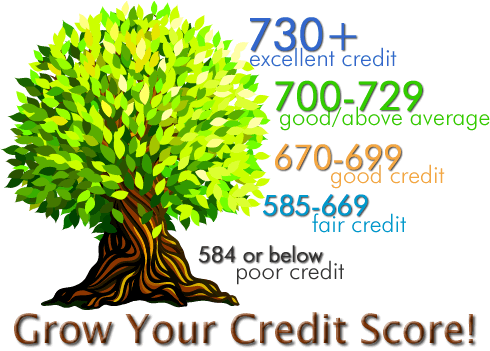
Improve Your Credit Score, even when you have Bad Credit!

Small, and sometimes significant, improvements to your credit score can be made with some relatively simple changes in behavior.

Always be cautious with your new found credit worthiness, that it doesn't end up leading you to even more credit problems.   Once your credit improves, instead of rushing out an getting things that won't help your financial future, consider using your new credit power to renegotiate your current credit, with lower interest rates so that your monthly bill is lowered, and contribute the difference to debt reduction.

It pains us, as debt collection attorneys in Florida, to see people that could be making small incremental changes to their credit behavior, that could ultimately find themselves out of debt.


Here's the 4 simplest ways to improve your credit.

1. Check your credit report for mistakes.


Yes, there's mistakes, there's identity theft, people forget to take paid bills off your record, you can track when certain debts ere set to expire and plan your credit accordingly.  How can you improve something without measuring it?   Check your score often!


2. Always pay bills on time.


A $200 Power bill, with a $50 late fee, and a $35 bounced check charge, followed by a $100 reconnect fee.... and your $200 power bill not only hurt your credit, but it cost you an extra $185, money that could have been used to help pay down other debts.   The world is far less expensive when you pay on-time.


3. Reduce your outstanding debt.


Even $10 extra with every payment.  The idea is lower the income to debt ratio.  Everything you pay, but don't consequently spend the new credit, will lower your credit score.  Making minimum credit card payments will sometimes not even cover your credit card fees and interest charges.  That means making minimum payments could even hurt you credit scores as the ratio of credit to available credit never changes, never goes down.


4.  Negotiate Credit Limits.


Here's a tricky one, because if a credit agrees to extend you more credit, the knee jerk want, is to go spend more money.  What we really want to see is a creditor granting you more credit, but you don't increase the amount of debt.  This increases the ratios of debt to available credit, and makes you look better on paper as you go and apply for that mortgage.

Try calling your credit card companies once or twice a year and asking for a credit increase.  A no answer won't hurt you, a Yes answer, will improve your credit score, as long as you are disciplined.

The simple truth is people with better credit scores, pay less for their credit.  If you were to diligently work on lowering your scores, and leveraging those scores into lower credit costs, the savings could be re-invested in paying off even more debt.. and in that never ending circle you find yourself on the road to responsible credit use, and a great credit score.